
Key figures
- 3,579 patients analysed: 1,258 monitored with Satelia® Cardio in addition to standard care, 2,321 receiving standard care alone, after propensity weighting
- 46% lower all-cause mortality: 23.5% versus 39.6% (HR 0.54; 95% CI 0.47-0.63; p < .001)
- 15% fewer heart failure hospitalizations (RR 0.85; p = .002)
- 32% fewer emergency department visits and 35% fewer intensive care admissions
- 75.0% survival at 24 months, versus 61.3% with standard care alone
- No average additional cost at 6, 12 and 24 months on total healthcare spending
TELESAT PRIOR-HF: real-world evidence in recently hospitalized patients.
Discharge is the most fragile moment in the pathway of a patient with chronic heart failure. In the months that follow, the risk of rehospitalization, emergency visits and death is at its highest. This is precisely the population addressed by TELESAT PRIOR-HF, a prespecified analysis of the national TELESAT-HF study published in the European Journal of Heart Failure.
The inclusion criterion is clear: at least one heart failure hospitalization in the 12 months preceding enrolment. Data cover August 2018 to December 2022, under real-world conditions of care, with a mean follow-up of approximately 20 months in each group.
TELESAT PRIOR-HF, published in the European Journal of Heart Failure.
Two groups compared after propensity weighting.
After propensity score weighting, the analysis compares 1,258 patients monitored with Satelia® Cardio in addition to standard care with 2,321 patients receiving standard care alone. The population reflects real-world heart failure: mean age 73 years and 33% women.
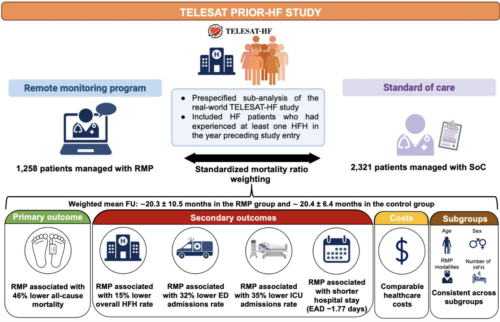
TELESAT PRIOR-HF study design: comparison between Satelia® Cardio remote monitoring and standard care.
Significant clinical outcomes in real-world use.
| Outcome | Satelia® Cardio (n = 1,258) |
Standard care (n = 2,321) |
Effect measure | p |
|---|---|---|---|---|
| All-cause mortality | 23.5% | 39.6% | HR 0.54 (0.47-0.63) | < .001 |
| Survival at 24 months | 75.0% | 61.3% | — | — |
| Heart failure hospitalizations | — | — | RR 0.85 (0.78-0.94) | .002 |
| Emergency department admissions | — | — | RR 0.68 (0.59-0.78) | < .001 |
| Intensive care admissions | — | — | RR 0.65 (0.53-0.79) | < .001 |
A useful benchmark for the size of the effect: the number needed to treat to prevent one death is 6.2 over 30 months. Benefits were consistent across subgroups, regardless of age (below and above 80), sex, number of prior heart failure hospitalizations, and regardless of the monitoring modality — web application or nurse-led telephone follow-up.
Clinical impact with no average additional cost.
| Time point | Satelia® Cardio | Standard care | p |
|---|---|---|---|
| 6 months | €13,067 | €12,873 | .892 |
| 12 months | €20,843 | €19,022 | .431 |
| 24 months | €31,374 | €27,160 | .182 |
None of these differences is statistically significant. The accurate wording is therefore not that remote monitoring generates savings, but that this study documents clinical impact with no average additional cost on total healthcare spending, even though the reimbursement of remote monitoring is included in the costs.
What this study does not show.
- This is an observational study. The authors state explicitly that the design precludes definitive causal inference. The results describe an association, not a demonstrated effect.
- Several clinical variables were unavailable: heart failure phenotype, NYHA class, ejection fraction, natriuretic peptides, frailty, treatment adherence, specialist follow-up intensity. Residual confounding cannot be excluded despite propensity weighting.
- Cause-specific mortality was not available, which limits mechanistic interpretation.
- Remote monitoring replaces neither emergency care nor the medical relationship. It is used in addition to standard care, under the responsibility of a healthcare professional.
Frequently asked questions.
What is the TELESAT PRIOR-HF study?
A prespecified analysis of the French national TELESAT-HF study, restricted to patients with at least one heart failure hospitalization in the 12 months before enrolment. It compares 1,258 patients monitored with Satelia® Cardio to 2,321 patients receiving standard care alone, over a mean follow-up of about 20 months.
What mortality reduction does TELESAT PRIOR-HF report?
All-cause mortality was 23.5% in the remotely monitored group versus 39.6% with standard care, a 46% relative reduction (HR 0.54; 95% CI 0.47-0.63; p < .001). Survival at 24 months was 75.0% versus 61.3%.
Does remote patient monitoring cost more to the healthcare system?
In this study, total mean costs per patient did not differ significantly between groups at 6, 12 and 24 months, including the reimbursement of remote monitoring. The finding is an absence of average additional cost, not a demonstrated saving.
Do these results apply to remote monitoring in general?
No. They concern Satelia® Cardio, in a specific real-world analysis, in patients recently hospitalized for heart failure. They are not transferable to other solutions or other populations.
Does telephone-based monitoring perform as well as the web application?
Subgroup analyses report consistent benefits across monitoring modalities, web-based or nurse-led telephone follow-up.
Read more.
Monzo L, Jourdain P, Jagu A, Seronde M-F, Benchimol H, Tartière J-M, Hanon O, Lafitte S, Barbet V, Pages N, Nisse-Durgeat S, Picard F, Girerd N. Association of patient-centred remote monitoring with clinical outcomes in patients with prior hospitalization: the TELESAT PRIOR-HF study. European Journal of Heart Failure. 2026.
Click here to download the study PDF
Also on the blog:
- TELESAT-HF: 36% lower all-cause mortality in 18,882 patients
- Satisfaction study: 87% of 825 patients with chronic heart failure
- Care pathway optimization and hospitalization reduction
- A 99.43% negative predictive value for the monitoring algorithm
- Satelia — remote patient monitoring for chronic heart failure