
Key figures
- A multicentre real-world study measures the negative predictive value of the Satelia® Cardio algorithm in remote monitoring of chronic heart failure
- Result: 99.43% negative predictive value
- Clinical reading: when the algorithm triggers no alert, the probability that the patient has no event over the period considered is very high
- The point is therefore not only to flag patients at risk, but to reliably identify those who are not
Identifying low-risk patients, not only those at risk.
Recommended by the European Society of Cardiology since 2021, remote patient monitoring in chronic heart failure aims to prevent decompensation and reduce hospitalizations. The usual logic is to detect patients who are deteriorating.
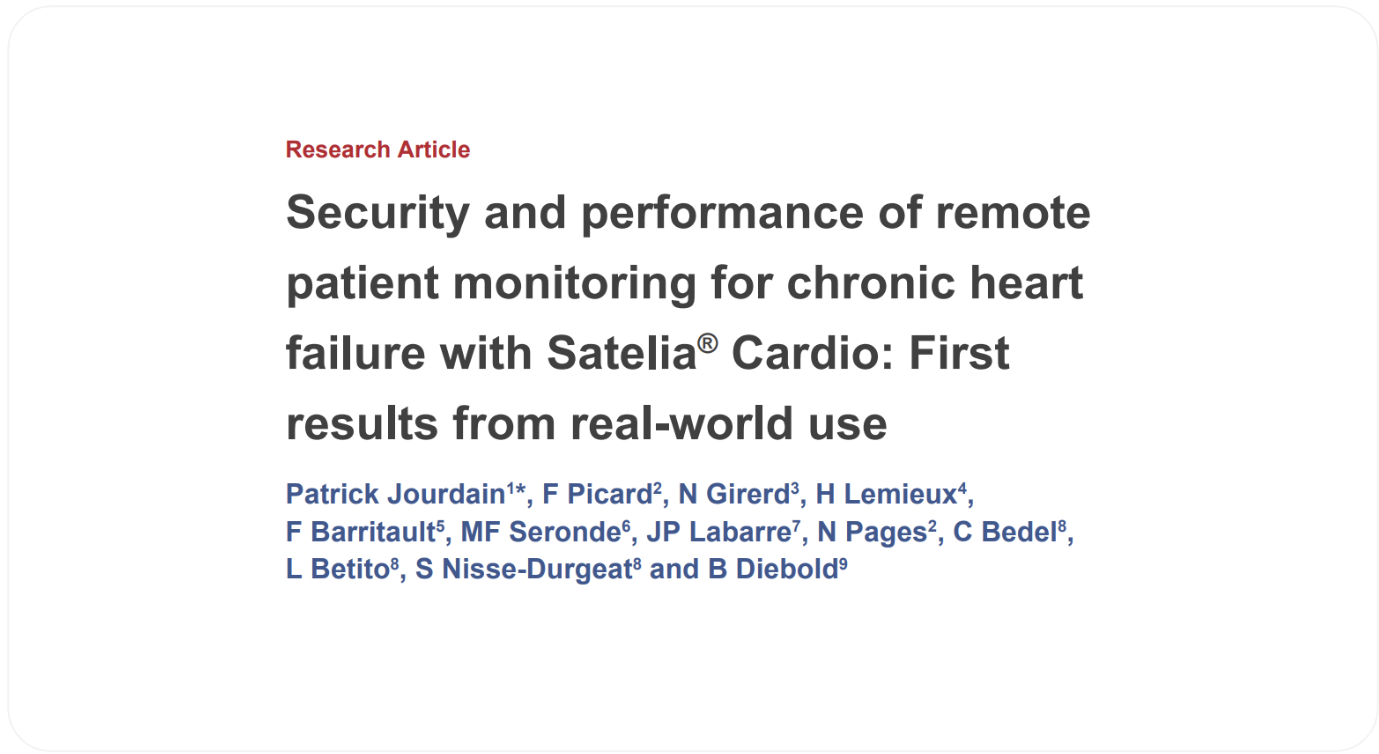
This study turns the question around: what if we also sought to identify, reliably, the patients who are not at short-term risk? That is the purpose of the multicentre study Security and performance of remote patient monitoring for chronic heart failure with Satelia® Cardio: first results from real-world use.
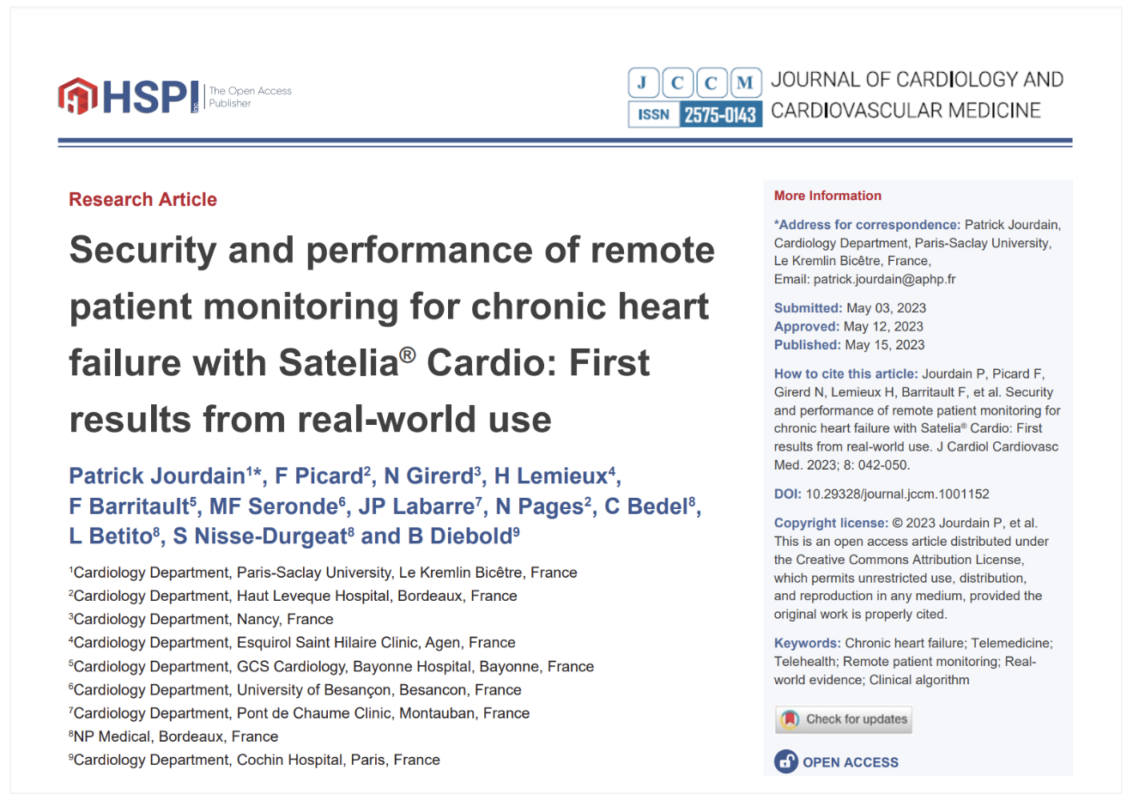
Jourdain P, Picard F, Girerd N, Lemieux H, Barritault F, et al. Security and performance of remote patient monitoring for chronic heart failure with Satelia® Cardio: First results from real-world use. J Cardiol Cardiovasc Med. 2023; 8: 042-050.
What is negative predictive value?
The negative predictive value (NPV) answers a precise question: when a test is negative, what is the probability that the person is genuinely free of what is being looked for?
Applied to a remote monitoring algorithm, it measures the reliability of the absence of an alert. A high NPV means that a patient with no alert has a very high probability of having no event over the period considered.
| Indicator | What it measures | Result |
|---|---|---|
| Negative predictive value | Reliability of the absence of an alert: probability that the patient has no event when the algorithm flags nothing | 99.43% |
The right patient at the right time.
The operational value is direct. A team following several hundred patients remotely cannot call them all. An algorithm whose absence of alert is reliable allows it to concentrate its time on the patients who need it, without missing the others.
In daily practice, this can translate into better targeted consultations: the right patient, at the right time. It is also what makes scaling up a remote monitoring programme sustainable.
What this study does not show.
- A negative predictive value is not a measure of clinical efficacy. It characterises the performance of the algorithm, not the benefit to the patient. The latter is addressed by cohort studies such as TELESAT-HF and TELESAT PRIOR-HF.
- These are first real-world results, without a randomised comparator group.
- No algorithm is infallible. Satelia® Cardio is not an emergency system and is used under the responsibility of a healthcare professional, in addition to standard care.
Frequently asked questions.
What is the negative predictive value of a remote monitoring algorithm?
It is the probability that a patient genuinely has no event when the algorithm does not trigger an alert. It measures the reliability of the absence of a signal, not the ability to detect at-risk patients.
What negative predictive value does the Satelia® Cardio algorithm reach?
99.43%, according to the first real-world results of the multicentre study on the safety and performance of the device.
Why does a high negative predictive value matter in practice?
It allows a care team to concentrate its time on the patients who need it, without fearing that it is missing those the algorithm does not flag. This is a direct sustainability issue for a large-scale remote monitoring programme.
Does this prove that remote monitoring reduces hospitalizations?
No. This study characterises the performance of the algorithm. The link with clinical outcomes is addressed by other work, notably TELESAT-HF and TELESAT PRIOR-HF.
Read more.
Security and performance of remote patient monitoring for chronic heart failure with Satelia® Cardio: first results from real-world use.
Also on the blog:
- TELESAT-HF: 36% lower all-cause mortality in 18,882 patients
- TELESAT PRIOR-HF: -46% mortality in recently hospitalized patients
- Satisfaction study: 87% of 825 patients with chronic heart failure
- Care pathway optimization and hospitalization reduction
- Satelia — remote patient monitoring for chronic heart failure