
Key figures
- 825 patients surveyed during the French ETAPES programme: 400 answering online independently, 425 by phone with a nurse
- 87% reported being satisfied with the digital monitoring of their chronic heart failure
- 94% found the application easy to use, 96.5% easily accessible, 89% understandable
- 99% considered that answering the questionnaire did not require an unreasonable amount of time
- 70% felt remote monitoring helped their physician provide better care (mean score 7.98/10)
- 98.1% of the 425 patients with low digital literacy found the telephone follow-up simple and fast
A declarative survey of 825 patients during the ETAPES programme.
Chronic heart failure is a long-term condition punctuated by decompensations that lead to hospital. Between two consultations, what matters happens at home: weight, breathlessness, oedema, fatigue. This is exactly what remote patient monitoring aims to capture.
In France, the experimental ETAPES programme, funded by the Ministry of Health, allowed these follow-up pathways to be deployed at scale before routine reimbursement. The first satisfaction survey of Satelia® Cardio users was conducted in that setting and published in Annales de Cardiologie et d’Angéiologie.
The follow-up principle is simple. Patients regularly answer eight questions: seven on symptoms, one on weight. These patient-reported data are transmitted to the care team, which is alerted when a concerning signal appears.
A decisive feature of this study: two answering modalities coexisted, depending on the patient’s digital literacy.
- 400 digitally literate patients answered online, independently, through the web application;
- 425 patients with low digital literacy answered by phone, with a nurse.
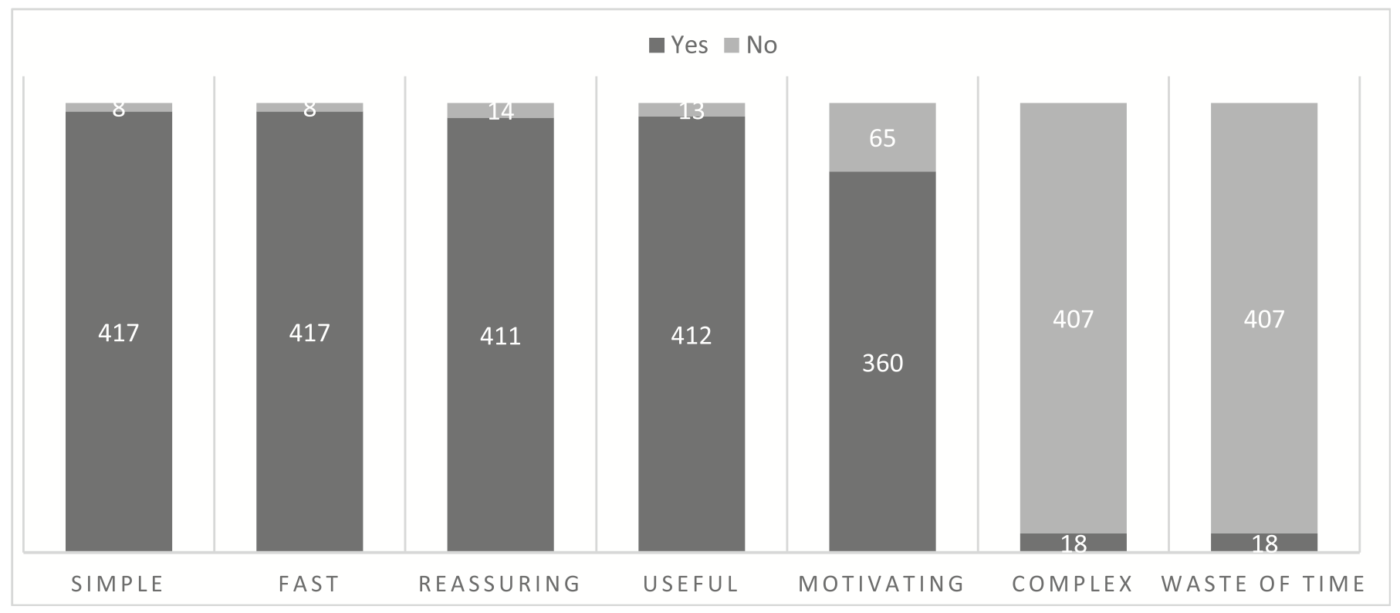
Satisfaction and adherence of 425 patients with congestive heart failure (CHF), having low digital literacy, when using the Satelia Cardio remote monitoring application.
An application rated simple, accessible and fast.
| What patients reported about the application | Proportion |
|---|---|
| Did not require an unreasonable amount of time to answer | 99% |
| Provided well-timed notifications | 98% |
| Easily accessible | 96.5% |
| Problem free | 95% |
| Easy to use | 94% |
| Understandable questions | 89% |
| Overall satisfaction with follow-up | 87% |
These figures deserve a cautious reading: this was a voluntary survey, more likely to be answered by patients engaged in their follow-up. They do indicate, however, that the tool was not a practical obstacle for the vast majority of respondents.
What about the 425 patients with low digital literacy?
This is the most interesting contribution of the publication, and the least often quoted. More than half of the cohort, 425 of 825 patients, could not use the web application independently. They were not excluded from the programme: they were followed by phone, with a nurse, on the same questions.
| The telephone follow-up is… | Yes | No | Share of “yes” |
|---|---|---|---|
| Simple | 417 | 8 | 98.1% |
| Fast | 417 | 8 | 98.1% |
| Useful | 412 | 13 | 96.9% |
| Reassuring | 411 | 14 | 96.7% |
| Motivating | 360 | 65 | 84.7% |
| Complex | 18 | 407 | 4.2% |
| A waste of time | 18 | 407 | 4.2% |
Fewer than 5% of these patients described the arrangement as complex or a waste of time, and 96.7% found it reassuring. The authors are explicit: patients with low digital literacy may need human-based or assisted remote monitoring. Access to remote monitoring does not depend on the quality of the application alone, but on whether an alternative pathway exists for those who cannot use it independently.
What patients perceive of the benefit.
- 70% of patients considered that remote monitoring helped their physician provide better care during follow-up, with a mean score of 7.98 out of 10;
- 45% of digitally literate patients reported an improvement in their quality of life.
Both are perceptions, not measurements. That a patient believes their physician is better informed says nothing about the actual organisation of care, and self-reported quality of life is not quality of life measured with a validated instrument.
What this study does not show.
- This is a declarative, voluntary survey, exposed to selection bias of unknown magnitude.
- No clinical endpoint was assessed: no mortality, hospitalization or emergency visit data. These questions are addressed by other work, notably TELESAT-HF and TELESAT PRIOR-HF.
- There was no comparator group. The study describes users’ experience; it does not compare it with that of patients not remotely monitored.
- No clinical variables were collected (NYHA class, ejection fraction, comorbidities), precluding severity-adjusted analyses.
- A conflict of interest is declared: several authors are employees of NP Medical, the manufacturer of Satelia® Cardio.
Frequently asked questions.
How many patients took part in this satisfaction survey?
825 patients with chronic heart failure, all users of Satelia® Cardio within the French ETAPES programme: 400 answering online independently and 425 answering by phone with a nurse.
Do you need to be comfortable with digital tools to be remotely monitored?
No. In this study, 425 of the 825 patients had low digital literacy and were followed by phone with a nurse, answering the same questions. 98.1% of them found this follow-up simple and fast, and fewer than 5% found it complex or a waste of time.
Does remote monitoring improve quality of life in heart failure?
In this survey, 45% of digitally literate patients reported an improvement in their quality of life. This is a patient-reported perception, not a measurement obtained with a validated instrument.
Does this study demonstrate a clinical benefit of remote monitoring?
No. It addresses reported experience and satisfaction only, without clinical endpoints or a comparator group. Clinical data on Satelia® Cardio come from other work, notably TELESAT-HF and TELESAT PRIOR-HF.
What was the ETAPES programme?
ETAPES was the French experimental programme funded by the Ministry of Health that framed and funded medical remote monitoring until 31 December 2022, before its inclusion in routine reimbursement on 1 July 2023.
Read more.
Jourdain P, Pages N, Amara W, Maribas P, Lafitte S, Lemieux H, Barritault F, Seronde M-F, Labarre J-P, Chaouky H, Bedel C, Betito L, Nisse-Durgeat S, Picard F. Perceptions and satisfaction of patients with chronic heart failure when using a remote monitoring web application named Satelia® Cardio. Ann Cardiol Angeiol (Paris). 2023;72(3):101606.
Also on the blog:
- TELESAT-HF: 36% lower all-cause mortality in 18,882 patients
- TELESAT PRIOR-HF: -46% mortality in recently hospitalized patients
- A 99.43% negative predictive value for the monitoring algorithm
- Care pathway optimization and hospitalization reduction
- Satelia — remote patient monitoring for chronic heart failure