
Key figures
- 18,882 patients with heart failure analysed, across more than 300 hospital and office-based centres
- 5,357 patients monitored with Satelia® Cardio, compared with 13,525 patients receiving standard care, identified through the SNDS
- 36% lower all-cause mortality: HR 0.64 (95% CI 0.59-0.70; p < .0001)
- Four years of data collection, from 1 August 2018 to 31 December 2022, under real-world conditions
- Consistent results regardless of sex, age, disease severity and digital literacy
TELESAT-HF: a national cohort of 18,882 patients over four years.
TELESAT-HF (NCT06312501) is a French national multicentre cohort conducted between 1 August 2018 and 31 December 2022. It draws on data from more than 300 hospital and office-based centres, giving it a clinical diversity rarely achieved in this field.
| Group | Patients | Care received |
|---|---|---|
| Remote monitoring | 5,357 | Satelia® Cardio in addition to standard care: symptom and weight monitoring, alert algorithm, personalised therapeutic support |
| Standard care | 13,525 | Usual care, patients identified through the French national health data system (SNDS) |
| Total | 18,882 | — |
The population reflects real-world chronic heart failure and its comorbidities: mean age 72 years, 56% ischaemic heart failure, 86% hypertension and 31% diabetes.
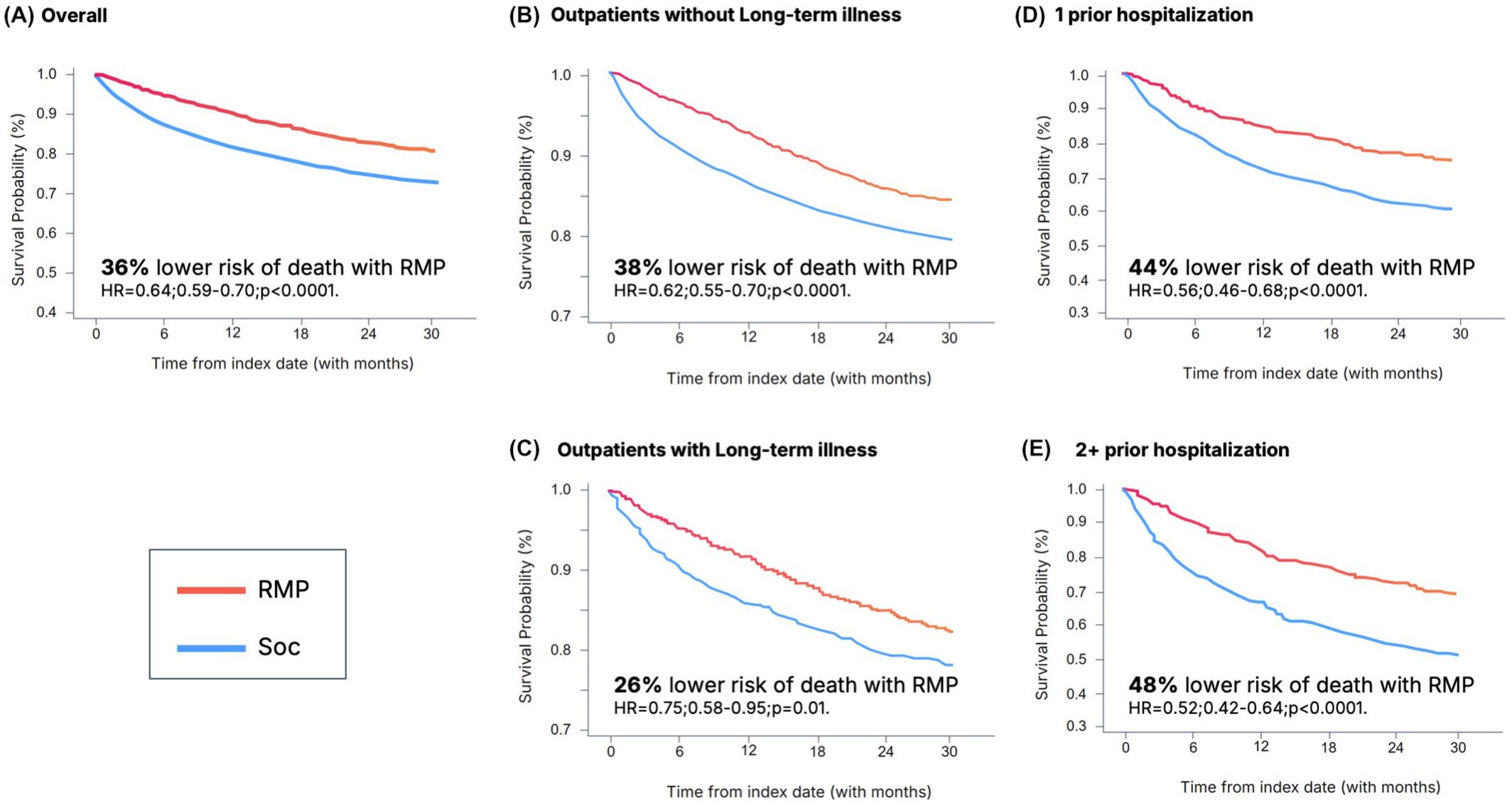
Figure 3 extracted from the publication. Kaplan–Meier survival curves of patients in the remote monitoring program (RMP) group versus the standard of care (SoC) group, overall (A) and according to heart failure (HF) hospitalizations and long-term illness (LTI) status (B–E). Hazard ratio (HR) in the overall population corresponds to weighted HR; HRs in the subgroups are derived from models adjusted for sociodemographic factors (age, sex, and deprivation index) and clinical characteristics (comorbidities and severity of HF).
A 36% reduction in all-cause mortality.
| Outcome | Effect measure | 95% CI | p |
|---|---|---|---|
| All-cause mortality | HR 0.64 | 0.59 – 0.70 | < .0001 |
Wording matters here. This is an observational real-world study: it documents an association between the remote monitoring programme and lower mortality; it does not establish causality.
Consistent results across all subgroups.
An important point for teams deploying a programme: the observed association remained consistent regardless of sex, age, disease severity and the patient’s digital literacy.
That last point echoes what the first Satelia® Cardio satisfaction survey documents: the benefit of follow-up is not limited to patients comfortable with an application. Patients monitored by phone with a nurse are not left behind by the programme.
Remote monitoring without connected devices.
The model evaluated relies on patient-reported symptoms and weight, without a connected scale or sensor. This is a deliberate design choice: it lowers the equipment barrier, reduces cost and makes follow-up accessible to older or less equipped patients.
The device combines these reported data with an alert algorithm and therapeutic support, so that the care team can act early. The reliability of that algorithm is addressed in a dedicated real-world study.
What this study does not show.
- This is an observational study. Despite propensity score analysis, residual confounding cannot be excluded. The results describe an association, not a demonstrated causal effect.
- Not all endpoints point the same way. While the association is favourable for all-cause mortality, time spent in hospital and emergency visits, it is neutral for heart failure hospitalization rates in the overall cohort. It becomes favourable in patients recently hospitalized, the population analysed in TELESAT PRIOR-HF.
- These results concern Satelia® Cardio, within this real-world analysis. They are not transferable to remote monitoring in general or to other solutions.
- Remote monitoring replaces neither emergency care nor the medical relationship. Satelia® Cardio is used in addition to standard care, under the responsibility of a healthcare professional.
Frequently asked questions.
What is the TELESAT-HF study?
TELESAT-HF (NCT06312501) is a French national multicentre cohort of 18,882 patients with heart failure, followed between August 2018 and December 2022 across more than 300 centres. It compares 5,357 patients monitored with Satelia® Cardio to 13,525 patients receiving standard care, identified through the French national health data system (SNDS).
What mortality reduction is remote patient monitoring associated with?
A 36% reduction in the risk of all-cause mortality: HR 0.64 (95% CI 0.59-0.70; p < .0001). This is an association observed in real-world conditions, not a demonstrated causal effect.
Is a connected scale required for remote monitoring?
Not with the model evaluated in TELESAT-HF, which relies on symptoms and weight reported by the patient, without connected devices. This design lowers the equipment barrier and makes follow-up accessible to older or less equipped patients.
Are the results the same for patients with low digital literacy?
The association observed remained consistent regardless of sex, age, disease severity and the patient’s digital literacy.
What is the difference between TELESAT-HF and TELESAT PRIOR-HF?
TELESAT PRIOR-HF is a prespecified analysis of the same study, restricted to patients with at least one heart failure hospitalization in the preceding year. It addresses a higher-risk population and reports larger reductions.
Read more.
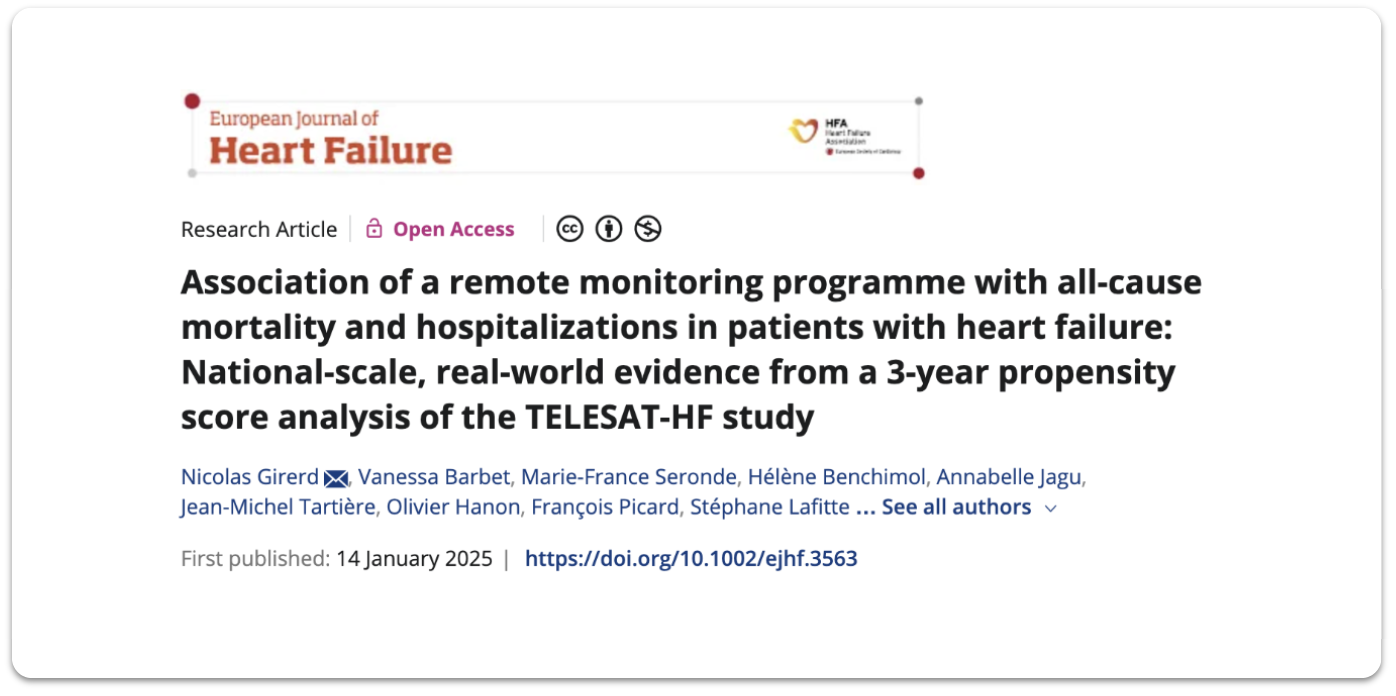
Girerd N, Barbet V, Seronde M-F, Benchimol H, Jagu A, Tartière J-M, Hanon O, Picard F, Lafitte S, Lemaitre M, et al. Association of a remote monitoring programme with all-cause mortality and hospitalizations in patients with heart failure: national-scale, real-world evidence from a 3-year propensity score analysis of the TELESAT-HF study. European Journal of Heart Failure. 2025;27:1658-1669.
Also on the blog:
- TELESAT PRIOR-HF: -46% mortality in recently hospitalized patients
- Satisfaction study: 87% of 825 patients with chronic heart failure
- A 99.43% negative predictive value for the monitoring algorithm
- Care pathway optimization and hospitalization reduction
- Satelia — remote patient monitoring for chronic heart failure