

Key figures
- 167 patients enrolled between January 2021 and December 2022, with a median age of 85 years
- 61.35% fewer rehospitalizations in the year following enrolment
- 5,323 questionnaires collected through Satelia® Cardio, generating 358 orange alerts and 29 red alerts
- Satisfaction: 8/10 among patients, 7.5/10 among healthcare professionals
- Twice-weekly remote follow-up carried out by trained nurses, alongside a multidisciplinary assessment
The Optimum programme: a structured pathway around the patient.
Set up at Médipôle Lyon-Villeurbanne, the Optimum programme is more than a remote monitoring tool. It is a complete care pathway built on three components.
| Component | Content |
|---|---|
| Laboratory follow-up | Regular tests allowing close monitoring of the patient’s condition |
| Multidisciplinary assessment | Day hospital one month after enrolment, involving geriatricians, dietitians and physiotherapists |
| Remote follow-up | Twice-weekly collection of symptoms and weight through Satelia® Cardio, carried out by trained nurses |
The aim: reduce rehospitalizations linked to chronic heart failure and improve patients’ quality of life.

Click on the image to discover the Optimum program in video (in French language).
167 patients, a median age of 85 years.
Preliminary results were presented at the 2023 French National Congress of Hospital Cardiology by Mehdi Aleyan, Laetitia Paradisi-Prieur, Sophie Nisse-Durgeat, Nicolas Pages, Hugo Bernelin and Carlos El Khoury.
The striking feature is the population: a median age of 85 years. That is well beyond the cohorts usually studied in remote patient monitoring, and it speaks directly to the question of accessibility in very old patients.
A 61.35% reduction in rehospitalizations at one year.
| Indicator | Value |
|---|---|
| Questionnaires collected through Satelia® Cardio | 5,323 |
| Orange alerts generated | 358 |
| Red alerts generated | 29 |
| Patient satisfaction | 8 / 10 |
| Healthcare professional satisfaction | 7.5 / 10 |
The alert volume is worth reading carefully: 387 alerts for 5,323 questionnaires, about 7% of signals. That is a workload a care team can sustain.
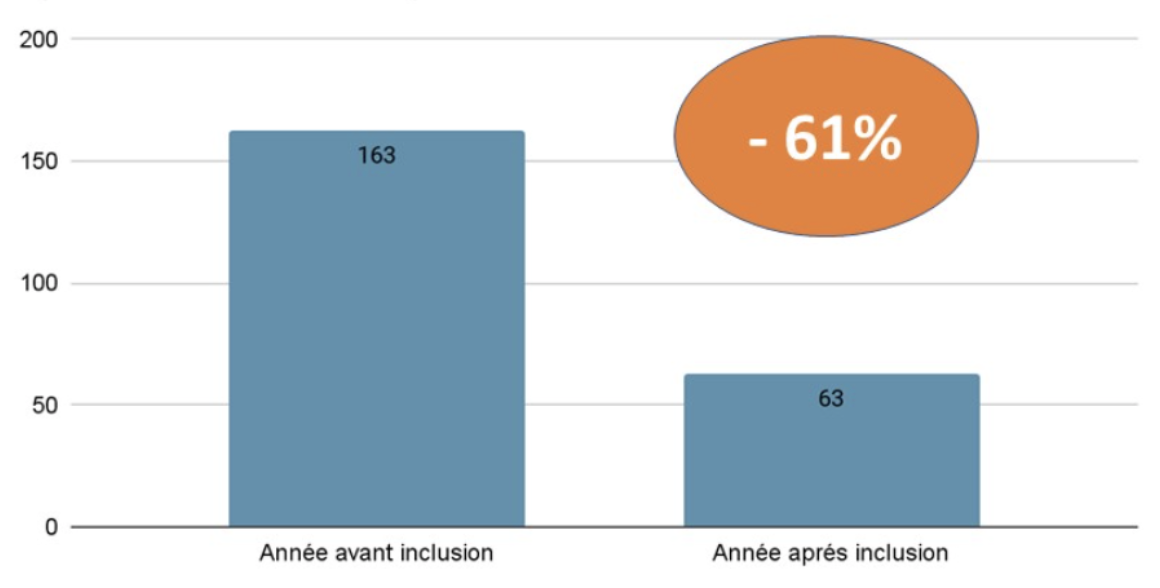
Number of hospitalizations for heart failure before and after inclusion in Optimum.
What this study does not show.
- There is no comparator group. The reduction compares the period after enrolment with the patients’ own prior situation. It cannot be attributed to remote follow-up alone.
- The programme is multi-component. Multidisciplinary assessment, laboratory follow-up and remote monitoring act together; the contribution of each cannot be isolated.
- These are preliminary results, from a single centre, presented at a congress.
- Remote monitoring replaces neither emergency care nor the medical relationship.
Frequently asked questions.
What is the Optimum programme?
A structured care pathway set up at Médipôle Lyon-Villeurbanne for patients with chronic heart failure, combining regular laboratory tests, a multidisciplinary day-hospital assessment and twice-weekly remote follow-up carried out by trained nurses.
Is remote monitoring suitable for very old patients?
In this programme, the median age of the 167 patients enrolled was 85 years, with a reported satisfaction of 8/10. Follow-up was carried out by trained nurses, which removes part of the barrier linked to digital autonomy.
What reduction in rehospitalizations is reported?
61.35% in the year following enrolment. In the absence of a comparator group, this result describes an association and cannot be attributed to remote follow-up alone.
How many alerts does a remote monitoring programme generate?
In this programme, 5,323 questionnaires generated 358 orange alerts and 29 red alerts, about 7% of signals.
Read more.
Aleyan M, Paradisi-Prieur L, Nisse-Durgeat S, Pages N, Bernelin H, El Khoury C. Le parcours de soins du patient insuffisant cardiaque chronique pris en charge aux urgences : réduction des réhospitalisations grâce au télé-suivi. Annales de Cardiologie et d’Angéiologie. 2023;72(5):101649.
Also on the blog:
- TELESAT PRIOR-HF: -46% mortality in recently hospitalized patients
- TELESAT-HF: 36% lower all-cause mortality in 18,882 patients
- Satisfaction study: 87% of 825 patients with chronic heart failure
- A 99.43% negative predictive value for the monitoring algorithm
- Satelia — remote patient monitoring for chronic heart failure